Speed: Outputs vs. Robustness
Speed doesn't degrade in five days. The ability to express it safely does.

Every performance coach knows the chart. Issurin’s residual training effects. It sits on the wall, lives in an Excel file, and gets cited in arguments for weekly sprint work.
But most coaches, myself included, took this chart at face value without asking the harder question: Where did the data come from & is it accurate?
Speed: 5 ± 3 days. That number became a mandate. Touch top speed weekly or watch your athletes get slower. That was the takeaway. That’s how the chart got weaponized.
Cult-like groups within the field still utilize this as the reason for including max speed weekly.
Jake Tuura raised this point recently, and he’s right. The residual training effect chart is never questioned and surely is inaccurate.
THE CHART
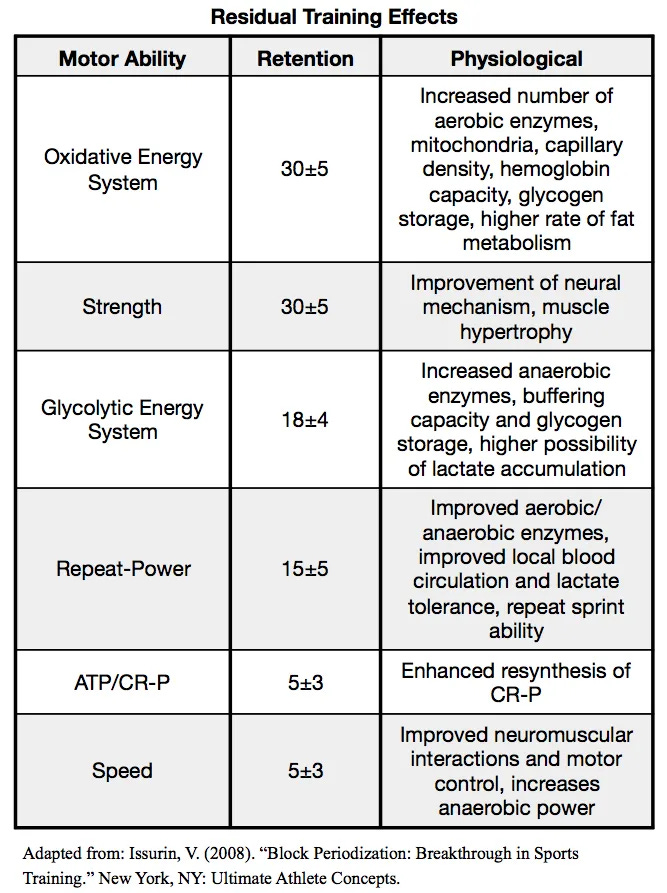
This is just flat out wrong.
The term “residual training effect” was first coined by Brian and James Counsilman in 1991 in the Journal of Swimming Research. It came out of swimming research, not track and field, not football. That’s the base the concept was built on.
There is no controlled sprint/speed-specific study that produced the “5 ± 3 days” number. It was extrapolated from detraining physiology and swimming research and applied universally.
Issurin noted that specific abilities are detrained much quicker than general abilities. Speed was not necessarily categorized as a general quality, but the specific quality of race performance. If this were the case, the chart would make much more sense.
SPEED DETRAINS THE FASTEST
Does it?
Athletes who get injured and come back through a return to play process, sometimes spanning weeks or months. Never have I witnessed an athlete with a significant drop in their speed capabilities when they return to full health.
The point: the 5-day residual window is probably not describing what we think it is. Speed, as a neuromuscular quality, doesn’t evaporate in a week. What accumulates, without consistent exposure, is injury risk.
This is the reframe. We’ve been asking: how do we keep athletes fast? The better question is: how do we give athletes the ability to run fast consistently, while making them faster in the process?
THE OUTPUTS TRAP
Early in my career, speed training had one north star: sprint times. Faster 40s, better fly-10s, improved top-end velocity. Low volume. Maximal intensity. Full recovery between reps. That model works if all you care about is the output.
It does not prepare athletes for sport, specifically for the demands of practices, training camp, and even games.
Speed reserve, as discussed in my first article, is flawed thinking. That article focused on how we build the aerobic system and enhance RSA, not how we prepare for the intensity elements of sport.
Chasing max outputs cannot come at the cost of preparing for sport.
PFF put out an article leading up to this year’s combine. One of the findings was that there is no significant statistical gap between a 4.4 and a high 4.5 WR. In fact, the low 4.4 athletes perform inferior to the high 4.5 athletes. Playing football is still a skill game.
Every year, athletes trot out onto the field in compressions and run a straight line 40-yard dash that somehow can drastically swing their draft status. Yet the data doesn’t support this.
Look at the simulcast below. Is the narrow gap between these athletes really a factor when we take into account the fact that they will have a defender in front of them, and the most important aspect of the route is the catch?
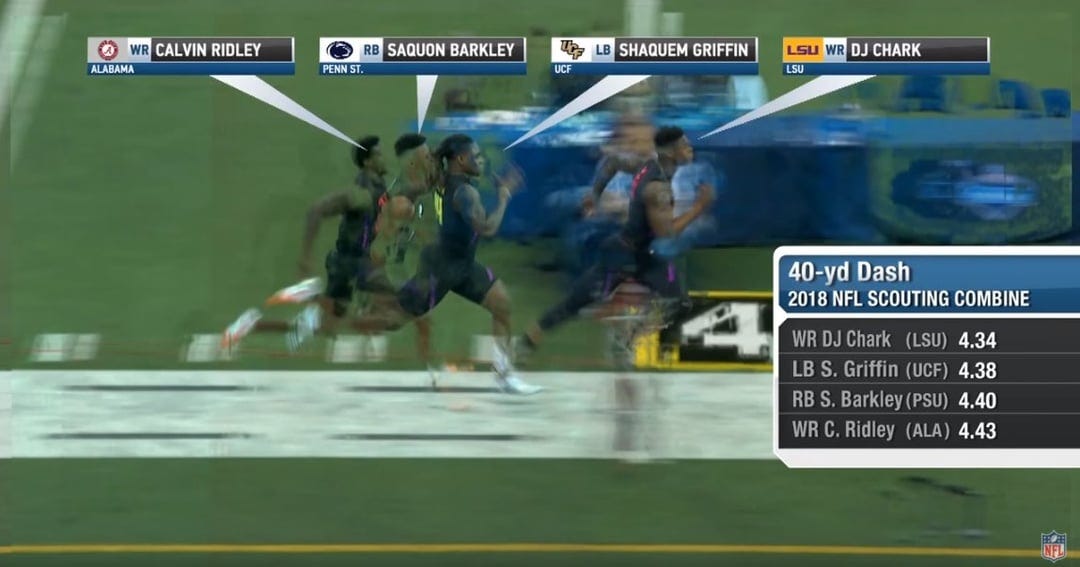
Speed and outputs are important. They are a barrier to entry to play the game, but once that barrier is met, other skills dictate success within the game.
WHAT WE’RE ACTUALLY TRAINING FOR
Football is not a 40-yard dash. It’s not fly-10s. It’s repeated high-speed efforts with incomplete recovery, over the course of a three-to-four-hour game, across a 12+ game season. The tissue has to be prepared for that demand. The neuromuscular system has to be trained to sustain it.
Low volume, max intensity sprint work builds output capacity. It does not build robustness.
Hamstring injuries spike when athletes hit speeds they haven’t trained at volume.
Max effort sprinting without accumulated high-speed distance is a risk, not preparation.
Top speed exposure matters for injury mitigation, not just performance output · Sport demands repeatability. Training must reflect that
Performance = Speed Output + Tissue Capacity + Availability
As I’ve progressed through my career, the model has shifted. We still build speed. Athletes still get faster. But we build it through volume of high-speed work, not just peak intensity. And a byproduct of that approach is we get both.
You can’t separate the performance conversation from the durability conversation. They’re the same conversation.
SPRINT-FLOAT > TIMED FLYS
Here’s the mechanism we’ve built around this philosophy: sprint-floats.
The premise is straightforward. Set a specific full-speed yardage. Athletes sprint to that point at full effort. When they hit it, they don’t decelerate. They float. They relax into the speed they’ve already built and hold it as smoothly as possible.
You can’t get faster unless you are timing.
This is where coaches get it wrong when they watch a video of 40 football athletes running waterfall starts and say, “nobody got faster.” What they’re missing: virtually every program at this level is running GPS tracking. Gathering, top speed, sprint distance, high output-yardage, all of it likely captured in real time. Many coaches are live-tracking speeds during the session itself. Just because there isn’t a set of timing gates on the field doesn’t mean nobody is measuring. The data is there.
I’ve run a lot of approaches over the years. Timing gates for fly-10s, build-ups, and full 40-yard dashes. Each has value. But what I’ve found works best is the sprint-float. In our last week of spring, 90% of our athletes hit a max speed PR in a single session, and every athlete hit a max speed PR during our spring phase. The structure: 25-yard sprint at full speed into a 15-yard float.
For most football athletes, 25 yards of full sprint puts them at or near top speed. That’s where the float begins. The cue is simple: relax and run as smooth as possible.
Slow is smooth and smooth is fast.
Football players habitually create excess tension in upright running. Backside-heavy mechanics dominate when athletes force speed rather than hold it. When the cue is smoothness, tension drops naturally. Relaxed mechanics at near-top speed produce better movement patterns than max-effort grinding. Athletes already at top speed, now running relaxed, frequently hit PRs on measured top velocity.
A big piece of the equation with top-end speed from both safety and outputs is running well. Sprint-floats provide the best platform to ensure athletes are learning to run with great mechanics and learning how to relax.
They were already fast. The float taught them to stay fast without fighting themselves. And every rep accumulates high-speed distance safely, building the tissue base that keeps athletes healthy enough to use that speed on game day.
Our primary goal is not speed PRs. It is high-speed distance and high-output-yardage accumulation. Preparing the athletes for the demands of games, practices, and training camp.
The byproduct of it is speed PRs.
REFRAMING THE RESIDUAL CHART
The premise of the residual effect of speed was wrong, but through a different lens is can still be useful. The chart is telling you that athletes lose speed in five days without sprinting. This is wrong. Now look at it through the lens of: Athletes lose the ability to sprint at max speeds safely if we don’t touch top speeds routinely.
Consistent top-speed exposure is critical for hamstring injury mitigation. That exposure doesn’t have to come from 2-3 timed fly sprints. Sprint-floats accumulate high-speed distance at true top velocity. The athlete gets faster. The tissue gets prepared. We help athletes stay available.
We moved from a model that chased sprint times to a model that builds the capacity to sprint repeatedly, at top speed, under fatigue, across a full season.
Build the speed. Build the tissue.
THE BOTTOM LINE
Issurin’s chart is wrong, but it doesn’t mean it isn’t useful.
Speed as a quality is far more durable than a 5-day window suggests.
What degrades is the tissue’s readiness to express it safely.
Consistent high-speed exposure matters for durability, not just output.
Outputs still matter, but repeated outputs and remaining healthy are the top priorities.
Get them faster. Keep them available. That’s the job.
Stress inoculation