Intensity & Intent
The Rise of Adam Archuleta- From Walk On, to First Round Pick

As a young kid growing up in St. Louis, who was a sports fanatic from an early age, Adam Archuleta was my hero.
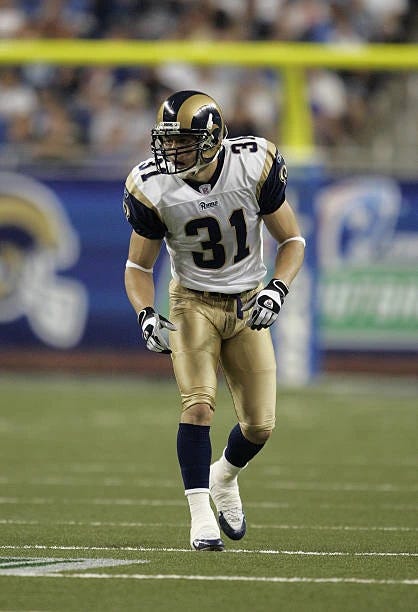
I remember closely following the NFL draft and combine prep, thinking this guy is an absolute freak. As a first-round pick to the Rams, he excelled immediately, and his style of play was impossible not to love. He played safety but had a triple-digit tackle season and logged 18 career sacks. Every game you watched, he was all over the field. The rare combo of a high motor guy, but with the physical tools you need to succeed.
As I grew older, I realized he wasn’t just my favorite player in the typical way kids pick a favorite player because of the jersey or the highlight reel. He was because he shaped how I thought about training before I even knew what training really was. His old workout videos were some of the first memories I have of exercise. The idea that you could utilize training to drastically change your performance has lived with me ever since. Clearly, as someone who has since dedicated their career to sports performance, but as an athlete, training is undoubtedly what separated me from many of my peers.
So when he started posting on Twitter recently, I paid attention. And what he’s been saying matters. The programming Jay Schroeder used with Adam was revolutionary, and I have taken many great things away from it, but that is a subject for another day.
The biggest thing Adam has talked about recently is not the sets, reps, or exercises used. Rather, the training intent and mindset that was demanded in each session.
The difference between athletes’ results every off-season is not the training program on paper. It’s the execution and habits that are brought in and out of every session.
William Wayland said it plainly recently on Twitter: “Intensity and intent are not the same. Confuse them, and you grind without gain.”
You can work hard and go nowhere. Most people do. Everyone in your position group has a program. What separates outcomes is what’s happening between your ears when you execute them. Your self-talk. Your level of presence. Whether you are actually there in each rep, or going through the motions.
Adam has been vocal about this. The physical preparation was never just physical. It was a deliberate construction of a mindset and an identity.
Think about 100 athletes entering an off-season with nearly identical goals. Same facility. Same coaches. Same 16 weeks.
The results will be wildly different.
Not because some got lucky. Not because some had better genetics (though it would be foolish to say they don’t matter, they do). Because intent is invisible at times, and it compounds. The guy who walks into every session with a clear picture of who he’s becoming does something subtly different than the guy just checking a box, and those subtle differences stack.
Now run that out for four or five years.
That’s how a walk-on at Arizona State becomes a first-round pick. That’s how a zero-star recruit makes an NFL roster. The gap isn’t built in a single training block. It’s built in the accumulation of intentional days when nobody is watching, and nothing is glamorous.
Movement Matters
One of Adam’s recent posts made this concrete in a way that stuck with me.
He quoted his trainer, Jay Schroeder: I don’t want you to squat 450 in 3 seconds. I want you to squat 350 in half a second.
That’s not a knock on being strong. It is an understanding that maximal strength is a by-product of great training.
“If all you have is a hammer, everything looks like a nail.” - Bernard Baruch
Maximal strength is not the only tool we should have in our toolbox as coaches, yet it is the one that most performance coaches emphasize.
To move a heavyweight at high speed, everything has to be right. Your technique, your positions, your ability to eccentrically load the movement rather than just dropping with gravity and hoping for the best. You can’t fake your way through it. Sloppiness that survives a slow rep gets exposed immediately when you’re trying to move with real intent and real velocity.
The payoff goes beyond the lift. That kind of training builds kinesthetic awareness, a feel for your body in space, under load, at speed, that transfers to everything else you do athletically. You move better. You react faster. You trust your body in competition because you’ve already demanded that precision from it in training.
Intent changes the stimulus entirely. Same weight, same movement, completely different adaptation.
Intent by the Numbers
Let’s make this tangible. Take this Monday’s football session. Sub-maximal day. Acceleration work on the field, then 10 sets of 2 on squat at 60% effort.
On paper, it looks light. And if you treat it that way, it is.
Let’s say we have two athletes squatting 300 pounds. Same bar, same weight, same program. One is going through the motions. One is attacking every rep with maximal tension and intent. The difference in what they’re actually producing is not small.
The athlete moving that 300 pounds at 1.2 meters per second is generating roughly 1,600 watts of power. The athlete drifting through the same rep at 0.7 meters per second is producing around 930 watts. That’s a 71% difference in power output on the same weight. Across 10 sets, that is a gap of 13,400 watts.
Same day. Same lift. Completely different training stimulus.
Multiply that across a full week, across a career. The athlete who brings intent to the session each day is building something the other one isn’t even touching. Not because he lifted more. Because he decided what the rep was going to mean before he got under the bar.
That’s the thing about intent. It is not always easy to see, and it can be difficult to measure.
“Not everything that can be counted counts, and not everything that counts can be counted." - William Bruce Cameron
Intent Compounded
Now zoom out and apply that same standard to everything in a single session.
Maximal intent in your dynamic speed prep. Maximal intent on every speed rep. Maximal intent on every lift. Not just the heavy ones. Not just when the coach is watching. Every single rep of every single thing.
I wrote about this in the misnomers of mental toughness a few weeks ago. This is what mental toughness actually is. It’s not gritting through pain. It’s bringing full presence to every moment of preparation, especially the moments that don’t feel important.
The best athletes don’t separate themselves through the quantity of their work. They separate themselves through the quality of it.
Everyone has had that athlete. Hey coach, I gotta get faster, what else can I be doing?
This isn’t a matter of addition; it’s a matter of multiplication.
You don’t need more volume, you need to bring intent to everything we do, an answer most usually hate because it’s not a quick fix.
Coach Wooden said it better than anyone: never mistake activity for achievement.
Think of an athlete who gets to the end of his college career, combine prep starts, and something clicks. The training intent goes up. The habits sharpen. He gives the process the focus it actually requires. Eight weeks later, the results are undeniable, and everyone acts surprised.
But here’s the real question. What if he had done that for four or five years of college?
That’s the invisible competitive advantage. It’s not a secret program. It’s not a special facility. Its intent applied consistently over time. The athletes who figure that out early will blow by their peers, and everyone will wonder why from the outside. The people there will all know why. They see the execution.
You cannot hide your intent and habits. First, you create your habits, then your habits create you.
Intent + time. That’s the formula. Everything else is just activity.
Training is Creation
Training is not just preparation for competition.
Training is creation. You are building the athlete and the person you’re going to be. Every session is either reinforcing that identity or drifting from it.
The physical output is the byproduct. Intent is the mechanism.
Get your intent right. The results follow.